
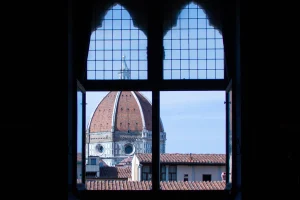
Planning a visit to Florence and wondering which pass is right for you? Florence is home to some of the world’s most visited museums — the Uffizi Gallery and the Galleria dell’Accademia. Both require timed reservations to avoid the long queues. Florence passes bundle the most important reservations into a single purchase, saving you hours of separate bookings across multiple systems. This guide compares all available options.
Affiliate Disclosure
Florence City Passes: All Options at a Glance
An important point to know before choosing your pass: the cathedral complex — Brunelleschi’s Dome, the Bell Tower, the Baptistery and the Cathedral Museum — is managed exclusively by the Opera del Duomo and is not included in any Florence museum pass. The Brunelleschi Pass is the dedicated ticket for the entire cathedral complex and is recommended as a complement to whichever museum pass you choose.
Florence City Passes
See all
Florence bestseller
The Florence Pass
Uffizi Gallery, Accademia Gallery, and Brunelleschi's Dome, all in one ticket!

Florence bestseller
Uffizi & Accademia: Reserved Entry Combo Ticket
Two of the most popular museums in Florence, all with one easy ticket
Florence
Florence Cathedral: Skip The Line + Optional Uffizi, Pitti & Boboli 5-Day Pass
Visit the large dome and see the frescoes inside
Which Florence Pass Is Best for Your Trip?
The Florence Pass is the best choice for visits of 1–2 days focused on the three highlights — Uffizi, Accademia and various options for the cathedral complex — all in one digital booking with no separate reservations. The Turbopass Florence suits visitors who want several days of broad access including a city tour and optional hop-on hop-off bus. The Firenze Card is the right choice for museum lovers spending 3 days with a full programme — pair it with the Brunelleschi Pass for the cathedral complex. For all passes: book Uffizi and Accademia slots 3–4 weeks ahead in high season; the Dome sells out even faster.
You are currently viewing a placeholder content from Stay22 maps. To access the actual content, click the button below. Please note that doing so will share data with third-party providers.
More InformationFlorence Pass

The Florence Pass is the most convenient choice for visitors with 1–2 days who want to see Florence’s three absolute highlights in one booking: the Uffizi Gallery, the Galleria dell’Accademia and various options for the cathedral complex. All timed reservations are included and managed digitally — no separate bookings on multiple platforms required.
Uffizi Gallery — reserved entry with audio guide
Galleria dell’Accademia — priority entry (Michelangelo’s David)
Climb of Brunelleschi’s Dome — subject to availability; alternatives are Giotto’s Bell Tower or a guided Cathedral tour
All reservations included — no separate booking needed
Fully digital — no on-site collection required
Smartphone audio guide app for 100+ points of interest
10% discount on further Tiqets bookings
Brunelleschi Dome & Cathedral
The Brunelleschi Pass is the dedicated ticket for the entire cathedral complex on the Piazza del Duomo: Brunelleschi’s Dome climb, the Bell Tower, the Baptistery, the Cathedral Museum and the crypt. It is the ideal complement to the Firenze Card and the Turbopass, neither of which includes the cathedral complex. Book as early as possible — the Dome is one of the fastest-selling tickets in Florence, with popular time slots selling out several weeks in advance.
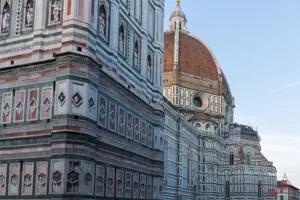
Climb of Brunelleschi’s Dome — timed reservation included
Bell Tower (Giotto’s Campanile)
Baptistery of San Giovanni
Cathedral Museum (Opera del Duomo)
Cathedral entry via the crypt
Valid 3 days from first use
Perfect complement to the Firenze Card and Turbopass
No museum access — museums require separate tickets or a museum pass
Florence Turbopass
The Florence Turbopass is a flexible multi-day pass valid for 1 to 7 days, giving free or reduced entry to a wide range of museums, churches and cultural sites — including the Uffizi and the Accademia with timed reservations, a guided city tour, and an optional hop-on hop-off bus. For visitors who want to explore beyond the top three highlights, it is the most comprehensive option. Add the Brunelleschi Pass separately for the cathedral complex.
Uffizi Gallery — reserved entry included
Galleria dell’Accademia — reservation included
Guided city tour included
15+ museums, churches and cultural sites
Hop-on hop-off bus as optional add-on
Cathedral complex (Brunelleschi’s Dome) not included — add Brunelleschi Pass separately
Firenze Card
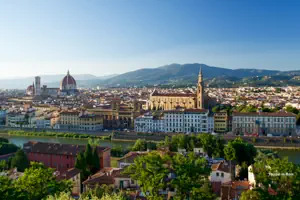
The Firenze Card is the official museum pass of Florence, issued by the Comune di Firenze. Valid for 72 hours from first use, it covers 60+ museums, galleries and palaces — including the Uffizi, Accademia, Palazzo Pitti, Boboli Gardens, Bargello, Medici Chapels, Museo di San Marco and many more. The right choice for museum-intensive visitors spending 3 days in Florence. Two important caveats: timed reservations for the Uffizi and Accademia must be made separately via the Firenze Card app or by phone; and the cathedral complex is not included — the Brunelleschi Pass is the recommended complement.
60+ museums and monuments in Florence and surroundings
Skip-the-line access at most participating venues
Children under 18 from EU countries admitted free with a cardholder
Only worth it if visiting 5+ museums in 72 hours
Uffizi and Accademia: separate timed reservations required (app, phone or ticket office)
Cathedral complex not included — Brunelleschi Pass recommended
Must be collected on site
Why Does Florence Have So Much Art?
No city of comparable size has produced, collected and preserved as much art as Florence. The answer lies in a unique convergence of wealth, ambition and rivalry that played out over three centuries.
Florence became one of medieval Europe’s wealthiest cities not through conquests but through commerce. The wool trade, banking and the Florentine fiorino — the first gold coin to serve as an international currency — made the city’s merchant families extraordinarily rich. Wealth on this scale needed somewhere to go, and art became the most prestigious investment available.
The Medici family transformed this wealth into a cultural programme without parallel. From Cosimo the Elder to Lorenzo the Magnificent, the Medici functioned simultaneously as bankers, political rulers and the most ambitious patrons in European history. They commissioned Brunelleschi’s Dome, funded Botticelli’s mythological paintings, supported the young Michelangelo and maintained a household of artists, philosophers and scholars. The Medici did not merely buy art — they shaped what art became.
Florence was the cradle of the Renaissance, the place where medieval religious painting gave way to a new vision of the human figure, perspective and the natural world. Giotto, Masaccio, Brunelleschi, Donatello, Botticelli, Leonardo, Michelangelo — this is not a coincidence of birth but the product of a city that valued artistic innovation and rewarded it financially.
Competition with Rome intensified Florentine ambition. When the papacy commissioned the Sistine Chapel, Florence responded with its own monuments. Michelangelo’s David — originally intended for the Cathedral — was placed in the Piazza della Signoria as a civic statement: Florence was the equal of any power in Italy.
Even Savonarola’s Bonfire of the Vanities in 1497, which destroyed countless paintings, mirrors and secular books, ultimately failed to extinguish Florentine art. The backlash against his purges reinforced the city’s commitment to its cultural inheritance. What survived became all the more precious.
The Sala dei Cinquecento in the Palazzo Vecchio tells another chapter of this story. Leonardo da Vinci and Michelangelo were commissioned to paint frescoes of victorious battles — a direct competition between the two greatest artists of the age — neither was completed. Leonardo’s experimental technique failed; Michelangelo left for Rome before transferring his cartoon to the wall. The ambition that drove the commission captures perfectly what made Florence unique: even the unfulfilled projects are historically significant.
The result of all this is the Uffizi Gallery, the Pitti Palace, the Bargello, the Medici Chapels, the Accademia and dozens of churches filled with original masterworks. Florence did not merely accumulate art — it generated the conditions that made art necessary.
The Most Important Museums in Florence
Florence has more museums per square kilometre than almost any city in the world. These are the ones that matter most:
Uffizi Gallery — The name comes from the Italian word for offices: uffici. Giorgio Vasari designed the building in 1560 as an administrative complex for the Florentine magistracies — a central office block connecting the Palazzo Vecchio with the Arno. The Medici soon appropriated the upper floor for their art collection, and what began as government offices became the greatest collection of Italian Renaissance painting in existence. Today it contains Botticelli’s Birth of Venus and Primavera, Leonardo’s Annunciation, Raphael’s portraits, Caravaggio’s Medusa and hundreds more. Advance reservation is essential: in peak season, slots sell out 4–6 weeks ahead. Included in all Florence passes.
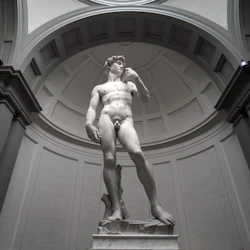
Galleria dell’Accademia — Here stands Michelangelo’s David, one of the most visited artworks in the world. Also contains Michelangelo’s unfinished Prisoners — figures appearing to emerge from the raw marble — and a significant collection of Florentine Gothic paintings. Reservations mandatory. Included in all Florence passes.
Vasari Corridor — One of the most extraordinary spaces in Florence. Giorgio Vasari designed this elevated private passageway in 1565 for Cosimo I de’ Medici, allowing the Grand Duke to move unseen between the Palazzo Vecchio, the Uffizi and the Palazzo Pitti across the Ponte Vecchio — above the heads of the city’s population. At nearly a kilometre in length, it passes through the Uffizi and over the Ponte Vecchio. Cosimo ordered the butchers who traditionally occupied the bridge to vacate — their smell was considered unworthy of ducal passage — and replaced them with goldsmiths and jewellers, whose workshops still line the Ponte Vecchio today. The corridor houses a remarkable collection of self-portraits donated to the Uffizi by artists from across Europe over three centuries. It is not included in any city pass — a dedicated Uffizi + Vasari Corridor ticket is required, bookable via Tiqets.
Palazzo Pitti — The largest palace museum complex in Florence, comprising the Palatine Gallery (Raphael, Titian, Rubens), the Royal Apartments, the Modern Art Gallery, the Costume Museum and the Silver Museum. Often overlooked by first-time visitors; extraordinary value per hour spent. Included in the Firenze Card and Turbopass.
Bargello National Museum — The finest collection of Renaissance sculpture outside the Uffizi. Donatello’s David — the first freestanding nude male sculpture since antiquity — Verrocchio’s David, and early works by Michelangelo. Undervisited and highly recommended. Included in the Firenze Card.
Medici Chapels — Michelangelo’s funerary sculptures for the Medici family: the allegorical figures of Day, Night, Dawn and Dusk. One of the most concentrated collections of Michelangelo’s mature work anywhere. Included in the Firenze Card.
Museo di San Marco — Fra Angelico’s frescoes painted directly onto the walls of the monks’ cells. Among the most serene and moving works of the early Renaissance. Included in the Firenze Card.
Palazzo Vecchio / Salone dei Cinquecento — The largest government hall in Italy. Up to 1,200 councillors would gather here for their deliberations. The hall, decorated by Vasari, remains extraordinary. Included with the Firenze Card; separate ticket otherwise.
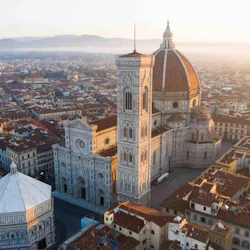
Brunelleschi’s Dome — The greatest feat of engineering of the Renaissance and the defining image of Florence. The climb up through the double-shell dome offers one of the finest views in Italy. The Brunelleschi Pass includes a timed reservation and should be booked several weeks in advance — in high season the Dome sells out faster than any museum in Florence. The Dome climb is also bookable via the Florence Pass, subject to availability.
Is Brunelleschi’s Dome included in Florence city passes?
Not in all passes. The Florence Pass includes entry to the Brunelleschi’s Dome climb (subject to availability) or alternatively Giotto’s Bell Tower or a guided Cathedral tour. The Firenze Card, Turbopass and other museum passes do not include the cathedral complex — the Brunelleschi Pass is the dedicated ticket and is recommended as a complement.
Do I need reservations even with a Florence pass?
Yes — for the Uffizi and Accademia, timed reservations are mandatory regardless of which pass you hold. The Florence Pass and Turbopass include these reservations in the booking process. With the Firenze Card, you must make reservations separately via the Firenze Card app, by phone or at a ticket office. Book as early as possible: in peak season, Uffizi slots sell out 4–6 weeks in advance.
What is the difference between the Florence Pass and the Firenze Card?
The Florence Pass (Tiqets) covers three attractions — Uffizi, Accademia and options for the cathedral complex — with all reservations handled digitally in one booking. It costs around €90 and is fully digital. The Firenze Card covers 60+ museums for 72 hours but requires separate reservations for the Uffizi and Accademia, does not include the cathedral complex, and must be collected on site. The Firenze Card is better value for museum-intensive visitors; the Florence Pass is more convenient for short visits.
How many museums does the Firenze Card include?
The Firenze Card gives access to 60+ museums, galleries, palaces and monuments in Florence and the surrounding area, including the Uffizi, Accademia, Palazzo Pitti, Boboli Gardens, Bargello, Medici Chapels, Museo di San Marco, Palazzo Vecchio and many more. It does not include the cathedral complex (Brunelleschi’s Dome, Bell Tower, Baptistery).
How far in advance should I book Florence passes?
For the Florence Pass and Turbopass, book 3–4 weeks ahead in high season (April–October) to secure your preferred Uffizi and Accademia time slots. The Brunelleschi Pass (Dome climb) often sells out even faster — book as early as possible, ideally 4–6 weeks ahead in peak season.
Is the Firenze Card worth it?
The Firenze Card is worth it if you plan to visit 5 or more museums in 72 hours and value skip-the-line access. If you are only visiting the Uffizi, Accademia and the Dome, the Florence Pass is more convenient and less expensive. For 1–2 day visits focused on the highlights, the Florence Pass is the better choice.
Car Rental Italy 2026 – Insurance, Costs & Essential Tips
A rental car is the ideal way to discover Italy flexibly and independently. Whether it’s the picturesque coastal roads of…>>>
ZTL Italy 2026 – Driving Bans in Rome, Florence & Milan
If you travel through Italy by car, you will sooner or later encounter a ZTL zone (Zona a Traffico Limitato)…>>>
Tolls in Italy 2026 – Costs, Telepass & Highway Tips
Almost all Italian motorways (autostrade) require a toll. Understanding how the toll system in Italy works before you set off…>>>