
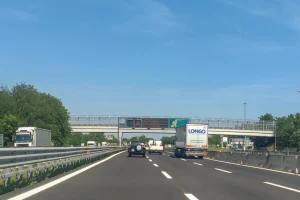
Almost all Italian motorways (autostrade) require a toll. Understanding how the toll system in Italy works before you set off saves time, avoids queues — and prevents the stress of ending up in the wrong lane. This guide covers everything you need to know: how to pay, what the Telepass is, where the Free-Flow system operates, and how speed is monitored on Italian highways.
Affiliate Disclosure
Toll Roads in Italy – Key Facts at a Glance
| Toll system | Distance-based ticket system on most motorways; Free-Flow on selected sections |
| Payment methods | Cash, credit/debit card, Telepass, contactless — depending on lane |
| Typical cost | Approx. €8–12 per 100 km for a standard car (Class A) |
| Telepass | Electronic device for automatic payment; yellow lanes; not mandatory |
| Free-Flow sections | A33, A36, A59, A60 — no toll booths; pay within 15 days at pedemontana.com |
| Speed control | Tutor (section control) + Autovelox (fixed cameras) + mobile police |
| Speed limit | 130 km/h dry; 110 km/h rain or drivers with less than 3 years’ licence |
| Toll calculators | autostrade.it (Autostrade network) and viamichelin.com (all operators) |
Activities in Italy
See all
Colosseum
Visit Rome’s impressive Colosseum, once home to gladiators and chariots; book admission online early due to high demand

Vatican Museums
Catch a glimpse of one of the greatest art collections in the world, including Michelangelo’s famed Sistine Chapel

Duomo di Milano
Visit Italy’s largest church with instant digital tickets to skip the line and access Milan Duomo’s famous rooftops
How the Italian Motorway Toll System Works
The Ticket System (Sistema a Casello)
The vast majority of Italian motorways use a distance-based ticket system. Here is how it works step by step:
- Entry: Drive into a lane marked Biglietto (ticket) and press the button or take the ticket that is already sticking out of the machine. The barrier rises automatically. Keep this ticket — losing it means you are charged from the first possible entry point to your exit, which is always the maximum possible toll for that route.
- Exit: At your motorway exit, pull up to the toll booth and insert your ticket. The display shows the amount due. Pay by cash, card, or contactless — then the barrier opens.
- Wrong lane: If you accidentally pull into a Telepass-only (yellow) lane without a device, press the red AIUTO (help) button. An operator will assist you and issue a printout with instructions for paying your toll online.
Toll Costs in Italy
Toll fees depend on the distance travelled, the vehicle class, and the motorway operator (different concessions charge slightly different rates). As a general guide for a standard car (Class A):
- Approx. €8–12 per 100 km on most Autostrade sections
- Common tourist routes as a reference: Milan–Rome (A1, ~570 km) around €45–50; Milan–Venice (A4, ~265 km) around €20–25; Rome–Naples (A1/A3, ~220 km) around €15–20
- Alpine tunnels (Mont Blanc, Fréjus, Great St. Bernard) charge separate tolls in addition to Autostrade fees
- Motorcycles over 150cc pay the same Class A rate as cars; scooters under 150cc are not permitted on motorways
The Free-Flow System
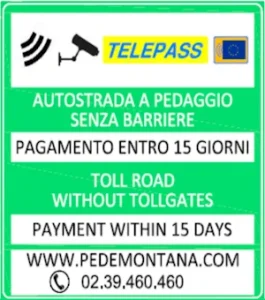
On several motorway sections in northern Italy, there are no toll booths at all. Cameras and sensors automatically read your licence plate as you pass through, calculate the distance, and the toll is billed afterward. This system is currently in operation on:
- A33 Asti–Cuneo (southwest of Turin)
- A36, A59, A60 Pedemontana Lombarda (northwest of Milan)
How to pay on Free-Flow sections: If you have a Telepass or compatible device, payment is automatic. Without a device, you must pay within 15 days via pedemontana.com or at an authorised payment point. Unpaid tolls after the deadline result in fines starting from €87, which can escalate significantly.
Telepass – Electronic Toll Payment in Italy

The Telepass is a small electronic device mounted on the windshield. When you drive through a yellow Telepass lane, the antenna above reads the device automatically and deducts the toll — no stopping required. It is the fastest and most convenient way to pay, but it is not mandatory.
Which Devices Work in Italy?
Several providers offer devices compatible with Italian motorways:
- Private vehicles: Telepass, UnipolMove, Tolltickets
- Commercial transport: AS24, Axxes, DKV Box Italia
Telepass for Tourists and Rental Cars
Tourists can subscribe to the European Telepass online before their trip — it works across several European countries and is particularly useful for extended road trips. Some car rental companies offer a Telepass a noleggio (rental Telepass) at vehicle collection, typically at €5–8 per day plus the actual tolls at standard rates. Whether this is worth it depends on your itinerary: for a trip involving many motorway sections it saves time; for a stay in one city with only two or three motorway excursions, paying manually at the booth is entirely practical.
Lane Selection at the Toll Booth
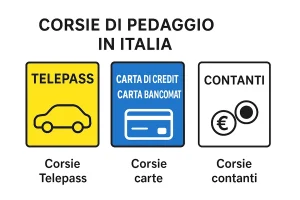
Choosing the right lane at the toll booth is one of the most common sources of confusion for first-time drivers in Italy. Here is what the lane markings mean:
- Yellow lane / T symbol: Telepass only — do not enter without an active device. The gate will not open and you may receive a fine for improper use.
- Blue lane / card symbol: Credit or debit card payment. Drive up, insert your ticket, and pay by card.
- White lane / coin/bill symbol: Cash payment. An attendant may be present, or it may be an automated machine.
- Blue + yellow lane: Accepts both Telepass and card payment.
- AIUTO button (red): If you enter the wrong lane or have a problem, press this button. An operator will assist you remotely.
Speed Control on Italian Motorways: Tutor and Autovelox
Italy uses two main systems for monitoring motorway speeds, and both are active across a large part of the network.
- Tutor (section control): Cameras at two points on a highway section record your licence plate and timestamp. The system calculates your average speed over the entire distance — so braking before a camera does not help. Signs are posted before sections under Tutor control. Exceeding the speed limit automatically generates a fine.
- Autovelox (fixed speed cameras): Point-speed measurement at a single location. Usually signposted in advance.
- Mobile police controls: The Polizia Stradale conducts speed checks from unmarked vehicles and at temporary positions.
Speed limits on Italian motorways: 130 km/h in dry conditions; 110 km/h in rain or for drivers who have held their licence for less than three years. Fines are issued automatically and can be sent to your home address or — for rental cars — billed via the rental company with an additional processing fee.
Planning Your Route: Toll Calculators
Before a longer motorway trip in Italy, it is worth calculating the expected toll costs in advance. Two reliable tools:
- autostrade.it — the official calculator for the Autostrade per l’Italia network (covers the main motorways but not all operators)
- viamichelin.com — calculates tolls across all Italian operators as well as cross-border routes into France, Austria, and Switzerland; also shows alternative toll-free routes
Note that not all Italian motorways are toll roads. State roads (Strada Statale, SS) are always free, as are most regional and provincial roads — they are slower, but often scenic alternatives worth considering for shorter legs of a journey.
FAQ: Toll Roads in Italy
Do I have to pay tolls on all Italian motorways?
Almost all motorways (Autostrade) in Italy are toll roads. State roads (Strada Statale, SS), regional roads, and provincial roads are always free. Some motorways managed directly by ANAS are also toll-free, but these are exceptions. As a rule: if the road sign has a green background and an A-number (A1, A4, etc.), expect a toll.
What payment methods are accepted at Italian toll booths?
Most toll booths accept cash, credit and debit cards, and contactless payment. Telepass lanes are reserved for drivers with an active device only. Not all lanes at every toll station accept all payment methods — look at the symbols above each lane before choosing. The AIUTO button connects you to an operator if you need help.
What happens if I accidentally drive into a Telepass lane?
Press the red AIUTO button immediately. An operator will speak to you through the intercom and issue a printout with instructions for paying your toll online. You will not be fined if you use the AIUTO button — the fine risk applies when you drive through without stopping and without paying.
What is the Free-Flow system and which motorways use it?
Free-Flow is a toll system with no physical barrier. Cameras read your licence plate automatically and the toll is calculated based on distance. It is currently used on the A33 (Asti–Cuneo) and the A36, A59, and A60 (Pedemontana Lombarda, northwest of Milan). If you do not have a Telepass, you must pay within 15 days at pedemontana.com or an authorised payment point. Unpaid tolls after the deadline result in fines from €87.
Is Telepass mandatory for driving in Italy?
No — Telepass is optional. You can pay manually at the toll booth using cash or card at any non-Telepass lane. Telepass is a convenience tool that speeds up payment, especially useful on longer motorway trips with many toll stations. For short trips or occasional motorway use, manual payment is completely practical.
What is the Tutor system and how does it affect me?
The Tutor is Italy’s section-based speed control system. Cameras at the start and end of a highway section record your licence plate and the time of passage. The system calculates your average speed over the distance — meaning you cannot simply brake before a visible camera. Signs indicate sections under Tutor control. Fines are issued automatically; for rental cars, they are sent to the rental company and billed to you with a processing fee.
What happens if I lose my motorway ticket?
If you lose the ticket issued at the entry booth, you are charged for the maximum possible distance from the first entry point on that motorway to your exit. This is always the highest possible toll for that route. Keep your ticket safe throughout the journey — if it helps, place it on the dashboard or passenger seat so it is ready at the exit.
Conclusion
Italian motorways are fast, well-maintained, and connect the country from the Alps to the tip of the boot — but they come at a cost. With a basic understanding of the ticket system, the lane markings, and the Free-Flow sections, paying tolls in Italy is straightforward. Calculate your expected costs in advance using autostrade.it or viamichelin.com, keep your ticket safe, and stay in the right lane at the booth. The Tutor system monitors average speeds across long sections — so consistent compliance with the speed limit is the safest strategy.
Car Rental Italy 2026 – Insurance, Costs & Essential Tips
A rental car is the ideal way to discover Italy flexibly and independently. Whether it’s the picturesque coastal roads of…>>>
ZTL Italy 2026 – Driving Bans in Rome, Florence & Milan
If you travel through Italy by car, you will sooner or later encounter a ZTL zone (Zona a Traffico Limitato)…>>>
Driving in Italy 2026 – Traffic Rules, Tolls & ZTL Zones
Italy is a wonderful country to explore by car — from the Alps to the Adriatic coast, through medieval hill…>>>